

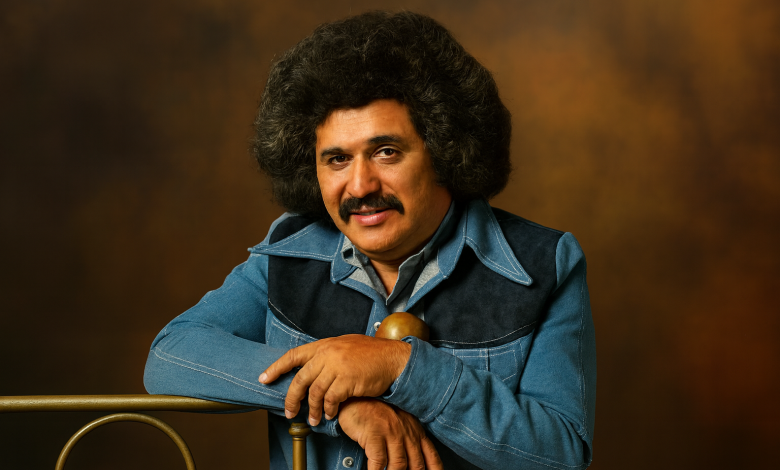
Freddy Fender was a highly influential American singer whose unique blend of country, Tejano, rock, and swamp-pop music helped bridge cultural and musical borders in the 20th century. His signature single “Before the Next Teardrop Falls” reached No. 1 on both the Billboard pop and country charts in 1975, marking his biggest hit and a landmark in crossover success.
He also scored several other major hits, including “Wasted Days and Wasted Nights,” “Secret Love,” and “You’ll Lose a Good Thing”, that became staples of his career. Fender served in the U.S. Marine Corps from 1953 to 1956, returning to civilian life before achieving musical fame. After a long career spanning nearly five decades, he died of lung cancer in 2006 at age 69, leaving a lasting legacy in American music.
Early Life
Freddy Fender was born Baldemar Huerta on June 4, 1937, in the El Jardín barrio of San Benito, Texas. He was one of five children in a Mexican American farmworker family. His father, Serapio Huerta, worked as a field laborer and died of tuberculosis in 1945, when Freddy was about seven years old. Afterward, his mother, Margarita Garza, raised Freddy and his siblings on her own, and the family lived in extreme poverty, at one point residing in a one-room tin shack with a dirt floor and no indoor plumbing.
As a child, Fender often worked alongside his family as a migrant farm laborer, traveling to harvest crops in various states. The family picked beets in Michigan, cucumbers in Ohio and Indiana, cotton in Arkansas, onions in New Mexico, and other crops as they followed the harvest seasons. Young Baldemar remembered being influenced by the music in the fields – for example, by the blues and gospel songs sung by African-American workers. He also grew up hearing the popular regional styles of conjunto, Tejano, and blues music common in South Texas. He learned Spanish at home and was taught to speak English at school.
Fender showed musical interest from an early age. At about ten years old he was given a battered guitar, and in 1947 (at age ten) he won a local singing contest with the Spanish song “Paloma Querida.” That same year he made his first radio performance, singing in Spanish on a Harlingen station. His mother later bought him a $9 Stella guitar, which he practiced diligently. He attended school in San Benito during his youth, but left formal schooling at about age 16.
| No. | Fact Category | Verified Information |
|---|---|---|
| 1 | Full Name | Born as Baldemar Garza Huerta on June 4, 1937, in Texas, USA. |
| 2 | Profession | American singer and songwriter in country and Tejano music. |
| 3 | Famous Song | “Before the Next Teardrop Falls” topped pop and country charts in 1975. |
| 4 | Music Genres | Known for country, Tejano, Tex-Mex, and swamp pop music. |
| 5 | Net Worth | Estimated $1–$5 million at the time of his death in 2006. |
| 6 | Military Service | Served in the U.S. Marine Corps from 1953 to 1956. |
| 7 | Awards | Won Grammy Awards as a solo artist and band member. |
| 8 | Bilingual Artist | Successfully performed songs in both English and Spanish. |
| 9 | Family | Married to Evangelina Huerta and had five children. |
| 10 | Death | Died on October 14, 2006, from lung cancer at age 69. |
Career and Legacy
Freddy Fender was an American Country and Tejano singer, known for his work as a solo artist and in the groups Los Super Seven and the Texas Tornados. His signature sound fused country, rock, swamp pop and Tex-Mex styles.
Professional Beginnings
Freddy Fender began his professional music career as a vocalist and recording artist in South Texas, first gaining regional recognition through Spanish-language rock and rhythm-and-blues recordings. Performing under multiple stage names early in his career, he developed experience in live performance, studio recording, and bilingual repertoire. His initial commercial releases focused on adapting contemporary American rock and pop songs into Spanish, helping him reach audiences in both the United States and Latin America. These early professional efforts established his reputation as a versatile singer capable of crossing language and genre boundaries.
After a temporary interruption in his career, Fender returned to professional music with a renewed focus on songwriting and vocal performance. He worked consistently as a live performer and recording artist, refining a sound rooted in country music while retaining strong influences from Tex-Mex, swamp pop, and rhythm and blues. This period laid the foundation for his later mainstream breakthrough.
Role Progression and Industry Contributions
Fender’s career advanced significantly in the mid 1970s when he emerged as a nationally recognized country artist. He transitioned from regional recordings to major commercial releases, taking on the role of lead vocalist and featured recording artist on chart-driven singles and albums. His ability to perform fluently in both English and Spanish became a defining professional asset, allowing him to appeal to diverse audiences within the country and pop music markets.
As his prominence grew, Fender contributed to the industry by normalizing bilingual recordings in mainstream country music. His work demonstrated that songs incorporating Spanish lyrics could achieve widespread commercial success without being confined to niche markets. Beyond his solo career, Fender expanded his professional scope by collaborating with other established musicians, participating in ensemble projects that blended traditional Tex-Mex instrumentation with contemporary country and rock arrangements.
In later years, Fender assumed leadership roles within collaborative groups, serving as a principal vocalist and creative contributor. His participation in Los Super Seven and the Texas Tornados reflected his commitment to collective musicianship and cultural preservation within a modern recording context.
Notable Career Milestones
One of Fender’s most significant professional achievements was achieving simultaneous number one positions on both the country and pop music charts with a bilingual single. This accomplishment marked a historic moment in American popular music and positioned Fender as a crossover artist with broad industry impact. He followed this success with multiple charting singles and albums that reinforced his commercial credibility and artistic consistency.
Fender received numerous industry honors during his career, including major awards recognizing his vocal performance and recording achievements. His work with the Texas Tornados resulted in critical acclaim and formal recognition for contributions to Mexican American music. Later, his involvement with Los Super Seven produced award-winning recordings that further solidified his reputation as a collaborative artist committed to musical heritage and innovation.
Toward the end of his career, Fender released a Spanish-language album that highlighted traditional Mexican American music. This project earned industry recognition and underscored his long-standing role as a cultural bridge within the recording industry.
Legacy and Lasting Influence
Freddy Fender’s professional legacy is defined by his role in expanding the boundaries of country and popular music. He demonstrated that Tex-Mex and bilingual recordings could achieve mainstream success while maintaining cultural authenticity. His career influenced later generations of artists seeking to integrate regional and ethnic musical traditions into commercial formats.
Within the music industry, Fender is widely regarded as a pioneering figure who elevated Mexican American representation in country music. His recordings continue to receive airplay, and his work remains a reference point for artists and historians examining cross-cultural contributions to American music. Fender’s sustained impact reflects a career built on adaptability, vocal excellence, and a lasting commitment to musical inclusivity.
Death
In his later years, he suffered from kidney and liver problems and in 2000 he was diagnosed with hepatitis C. He died on October 14, 2006 at his home in Corpus Christi, Texas. The cause of death was lung cancer. He was buried with military honours at the San Benito Cemetery in his hometown of San Benito, Texas.
Who was Freddy Fender’s wife?
Fender married Evangelina “Vangie” Muñiz on August 9, 1957. The couple divorced in 1963 after Fender’s release from prison that year.
Remarriage to Evangelina “Vangie” Huerta
About two years after their divorce, Fender and Muñiz (by then known as Evangelina “Vangie” Huerta) remarried in 1965. They remained married thereafter, staying together until Fender’s death in 2006.
How many children did Freddy Fender have?
Fender and his wife Evangelina Huerta had five children. These included two sons, Baldemar “Sonny” Huerta Jr. and Daniel Huerta, and two daughters, Tammy Huerta Mallini and Marla Huerta Garcia. (One other son died in a car accident.)
What was Freddy Fender’s net worth when he died?
At the time of his death, Freddy Fender’s net worth was estimated to be between $1 million and $5 million. He earned this through a decades-long music career in country and Tejano genres, producing hit songs such as “Before the Next Teardrop Falls.” Fender performed both as a solo artist and in successful groups like the Texas Tornados and Los Super Seven. These projects, along with record sales, tours and songwriting royalties, generated his wealth. He also won multiple Grammy Awards with both his bands and solo and continued performing into 2005.

